
Our offer is only for you if you are of legal age. Please confirm that you are at least 18 years old to proceed.


Why Is Hookah Tobacco So Expensive?
 Updated October 14, 2025 4 min
Hookah smokers notice it with every new tin: hookah tobacco costs significantly more today than a few years ago, and that is no coincidence. Between new taxes, legal regulations like the 25g law under Christian Lindner and manufacturing efforts, many factors have led to an exorbitant price increase. In the past you could still buy 200 g tins at moderate prices; then came the 25g rule, manufacturers had to switch over, packaging became more expensive, and the price per gram shot up. Since this rule was lifted for private individuals in July 2024, the situation has eased somewhat, but many effects continue to have an impact, and in the future further tobacco tax increases and additional taxes are to be expected.
What to expect in this article
- What makes up the price of hookah tobacco in the first place
- Why the 25 g rule turned the entire market upside down
- How much of the price ends up with the state as tax
- What role raw materials, energy and wages play
- How prices have developed over the past years
- Where the journey for tobacco prices is heading
Components of the price: what all gets factored in
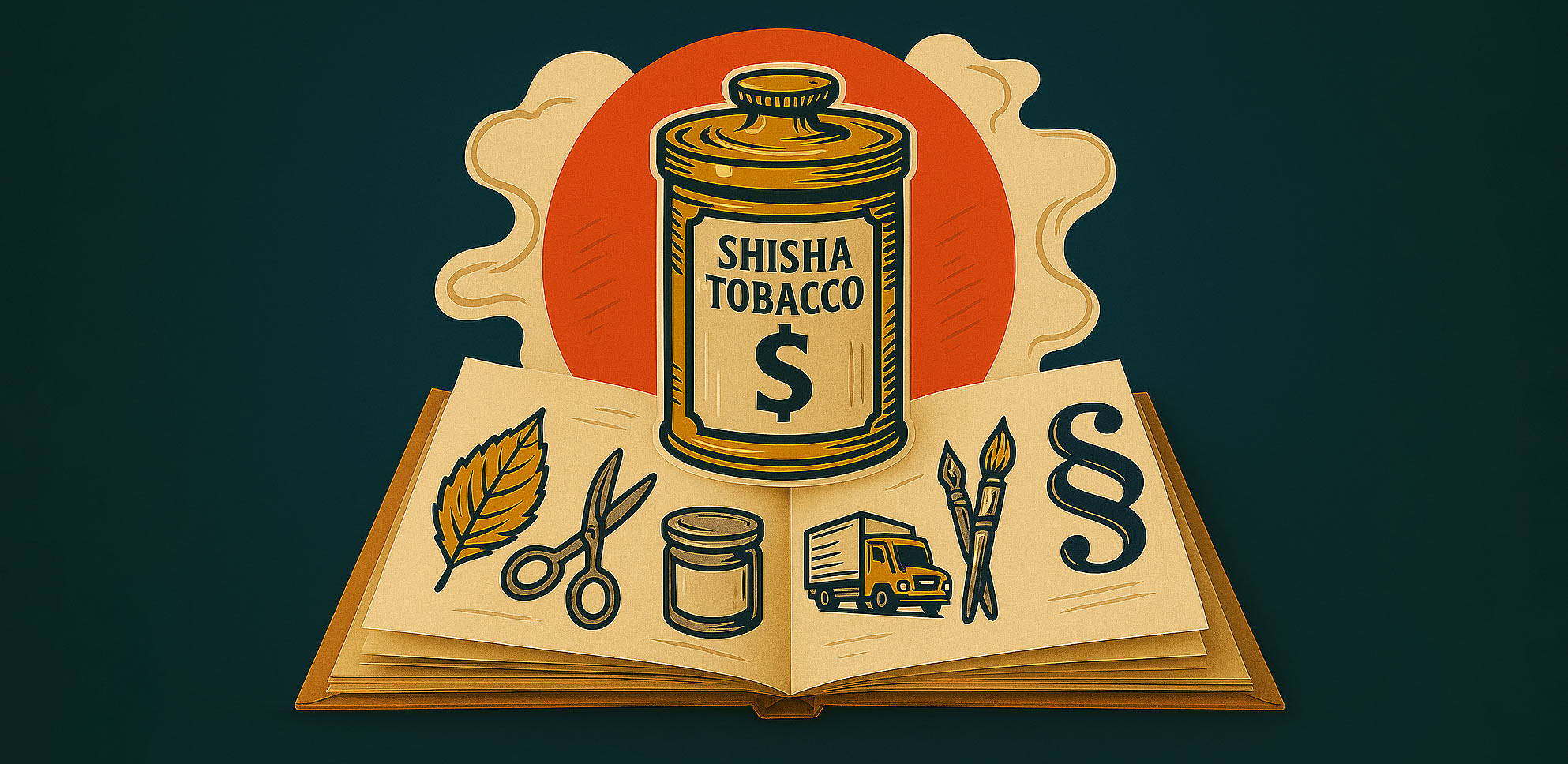
When you look at the price of hookah tobacco, there is more to it than you see at first glance. Here are the main components:
- Raw materials: raw tobacco (e.g. Virginia, Burley etc.), molasses/glycerine, flavourings, sweeteners. The quality, origin and nature of these materials have a big influence on the costs.
- Processing: washing/treating the tobacco, drying, cutting, flavouring, blending.
- Packaging costs: tin/container, label, design and printing costs. Special packaging costs more than standard tins. Smaller packaging sizes also cause the price per gram to rise.
- Transport & logistics: import of tobacco, shipping, warehousing, handling.
- Marketing & brand effort: brand awareness, graphic design, advertising, distribution. Large tobacco-product brands like Al Fakher charge for that too.
- Taxes & duties: hookah tobacco is taxed more heavily than ordinary pipe tobacco and is subject to a complex system of tobacco tax and additional duties.
These shares add up, and when one component becomes more expensive because demand is correspondingly high, that clearly shows on every gram.
The 25 g rule and its influence on price development
To curb tax evasion and revenue losses through hookah bars, a change to the tobacco tax was decided in 2021, which came into force in July 2022. It was implemented under Finance Minister Christian Lindner. This banned the sale of units larger than 25 g to private customers, and it was no longer possible for any consumer to legally purchase tobacco for hookahs in quantities larger than 25 g.
The 25 g rule (from July 2022) thus turned the market completely upside down once, with devastating consequences. Manufacturers had to switch over packaging and production. Instead of fewer large tins, a much higher number of small tins was suddenly needed. But the machine conversions as well as higher storage and staffing efforts were also factors that were reflected in the price.
The consequences:
- Manufacturers had to completely switch over packaging and production.
- Machines, logistics and staffing efforts increased.
- More packaging per gram meant a higher final price.
- Consumers paid over 30 € for 200 g (8 × 25 g) at times, instead of around 17 to 20 € before.
Since this limit was lifted for private customers in July 2024, larger packs like 200 g are allowed again. For hookah bars and wholesale, however, the regulation still applies. Learn more in our blog post: 200g hookah tobacco tins are coming back!.
Tax burden and further legal costs
Taxes are already a large part of the price with tobacco anyway:
- Tobacco tax: In Germany there are special tax rates. For pipe tobacco, for example, a share per kilo is set, plus further tax increases.
- Additional tax: Since 2022, an additionally raised tax rate applies to hookah tobacco, which rises annually until 2026.
- Legal requirements: packaging, age verification, ingredient declarations. These changes burden the producers and are ultimately passed on to the customers.
Example: the price of a tin of hookah tobacco with 200 g content (27.90 €) includes approx. 11 € tobacco tax and 4.45 € VAT. This means over 50 % of the price goes directly to the state.
When production and ingredients become more expensive
Another driver is rising costs for raw materials and production:
- Flavourings and molasses become more expensive, especially when they are imported.
- Energy and logistics costs: transport, storage and machine operation have all become more expensive.
- Labour costs: production, quality assurance, packaging and shipping need people, and wages are rising.
All of this creates an additional surcharge.
How prices have changed in recent years
Before the 25 g rule, a 200 g tin of Holster or Al Fakher tobacco was available for about 17.90 €. After the rule came, the costs rose so much that a purchase of 8 × 25 g often cost over 30 €. Today, 200 g tins typically range between 25 and 30 €.
| Period | Typical prices for 200 g / comparable packs* | Tax and regulatory measures & influencing factors |
|---|---|---|
| Before 2022 | 15.90 € – 17.90 € | Stable tax rates, no quantity limit, larger packaging common, less effort per gram. |
| From July 2022 | 8 × 25 g ≈ 32 € (equals the earlier 16–20 € / 200 g) | Introduction of the 25 g limit, additional tax, higher packaging and logistics costs. |
| 2023–2024 | 22.90 € – 25.00 € | Further tax increases, new packaging regulations, rising production costs. |
| From July 2024 | 25 € – 30 € | Return to 200 g tins, packaging costs fall, taxes remain high. |
| 2025 (expected) | 27 € – 30 €+ | Further tobacco tax increases, rising raw material costs, high energy costs. |
* Price figures are based on common brands and varieties (Virginia, classic varieties).
Trends: where is the journey heading?
What can be foreseen? With the lifting of the 25 g rule for private individuals, the market has opened up. Larger packs are back, which could have tended to lower the price per gram. Nevertheless, taxes continue to rise annually, which drives the price up anyway.
Conclusion
In contrast to many other countries within the EU, prices for hookah tobacco in Germany are still relatively moderate, yet the aftereffects of the 25 g rule and tax increases are clearly noticeable. The pricing results from many factors: raw materials, packaging, taxes, logistics, marketing and brand image. For the hookah community this means: enjoyment has become more expensive, and that will not change any time soon.
However prices may develop, in our online shop you will always find a large selection of hookah tobacco in various sizes.
FAQ: why hookah tobacco is so expensive
How expensive was hookah tobacco in the past compared to today?
A few years ago you could still get a 200 g tin of hookah tobacco for around 17 to 20 euros. Now the average price is just under 27 euros, and further increases are expected in 2026 as well.
Do Heat Not Burn products influence the hookah market?
Yes, but only slightly. Heat Not Burn products are not in direct economic competition with hookah tobacco, but they are politically, since they are treated completely differently for tax purposes yet are included in the same discussion. This different classification creates imbalances in the area of tobacco products. Many manufacturers and retailers demand equal conditions or a uniform tax treatment here, since otherwise other branches of the tobacco industry have a competitive advantage.
What effects does a tobacco tax increase have on the end consumer?
Every increase in the tobacco tax has direct effects: the sale price rises, which burdens the end consumer. This leads to declining consumption in the legal market and partly fuels the black market.
Why do tax revenues play such a big role with hookah tobacco?
The reason for the high tobacco prices lies to a considerable extent in the state duties. Over 50 % of the sale price goes to the state. The tax revenues from tobacco products and the like make up a relevant budget item for politics, which is why there are continuously new tax plans.
What role does the hookah tobacco business play compared to other tobacco products?
The hookah tobacco business is smaller compared to cigarettes, but it grows steadily. Young adults in particular are discovering the variety of products. However, the range is heavily regulated, which makes selling more difficult than with classic tobacco products.
How do media like the dpa report on tobacco prices?
News agencies like the dpa regularly report on developments in tobacco prices and tax plans. From a political perspective, hookah tobacco and similar products are often treated in the same breath as cigarettes, although consumption habits and markets are very different.
You might also be interested in
Knowledge