
Our offer is only for you if you are of legal age. Please confirm that you are at least 18 years old to proceed.


Your Guide to Vapes: Everything You Need to Know
 Updated 28.08.2025 5 min read
In a nutshell
- Vapes are electronic devices that vaporise flavoured liquids (e-liquids) instead of burning tobacco and have been on the market since 2003 – the terms vape and e-cigarette are often used interchangeably.
- The devices consist of five core components (liquid, battery, coil, tank, mouthpiece) and are considered less harmful than traditional cigarettes by comparison, but are by no means risk-free – young people and non-smokers in particular should avoid use.
- Even nicotine-free liquids can cause respiratory irritation and allergic reactions, as flavouring agents contained within them can release potentially harmful substances when heated, and the long-term effects have not yet been conclusively researched.
- In Germany, the purchase and use of vapes is legally restricted to persons aged 18 and over – this also applies to nicotine-free products; vaping on aircraft is prohibited, and country-specific regulations should be observed when travelling abroad.
- When disposing of vapes, they must be treated as electronic waste, as the lithium-ion batteries they contain must never be placed in general household waste, in order to avoid fire hazards and environmental damage.
Vapes are electronic devices that vaporise liquids instead of burning tobacco. This guide summarises all the important information about how they work, differences to e-cigarettes, health risks, legal aspects, and proper disposal.
What Are Vapes?
Vapes – also known as e-cigarettes, e-hookahs, or e-vaporisers – are electronic devices that heat a flavoured liquid (liquid) to produce an inhalable vapour. These liquids consist of various ingredients such as propylene glycol, glycerine, nicotine, and a wide variety of flavourings. The flavourings originally come from the food industry and are specially adapted by manufacturers for use in e-cigarettes. There is a wide variety of flavours – including menthol, mint, and cinnamon – which are particularly popular among young people. Cartridges (known as pods) serve as refill packs for liquids and are used in many devices. Unlike conventional cigarettes, no combustion takes place with vapes. This makes them an interesting alternative to the classic cigarette for many smokers.
Features:
- No tobacco, no combustion
- Wide variety of flavours
- Liquids available with or without nicotine
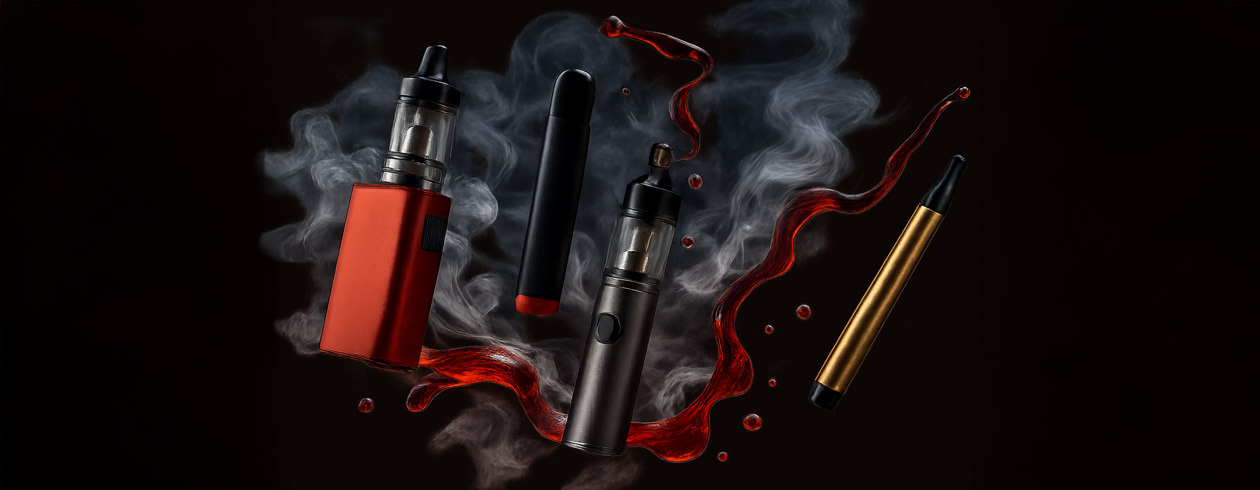
- Different device sizes: from disposable vapes to high-powered battery mods
- Many devices use interchangeable cartridges (pod systems), which serve as refill packs for various liquids and flavourings and allow easy switching of vapour or nicotine content
The Difference: Vape and E-Cigarette
In everyday language, the terms "vape" and "e-cigarette" are often used interchangeably. In both cases, the same principle is meant: vaporisation instead of combustion. However, the term "vape" derives from the English "to vaporise" and can also refer to other devices that vaporise liquids or substances – for example, inhalation devices for bronchial conditions or devices that vaporise plant matter or solid substances for inhalation.
Here is a table for a better overview:
| Merkmal | Vape (umgangssprachlich) | E-Zigarette (technisch korrekt) |
|---|---|---|
| Begrifflichkeit | Alltagsbegriff | Fachbegriff |
| Gerätevarianten | Einweg, Pod-Systeme, Mods | Meist Pod- oder Mod-Systeme |
| Fokus | Lifestyle & Convenience | Funktionalität |
| Nutzeransprache | Jüngere Zielgruppe | Fachhandel/ spezifischer Austausch |
| Nikotingehalt & Maße | Oft Liquids mit verschiedenen Nikotinstärken, maximal zulässige Maße: 20 mg Nikotin pro ml gemäß gesetzlicher Regelung | Strikte Einhaltung der gesetzlichen Obergrenze von 20 mg Nikotin pro ml; Maße und Inhaltsstoffe unterliegen regulatorischen Standards |
How Long Have Vapes Been Around?
First market-ready models: around 2003 (China) EU-wide spread: from around 2008 Boom in Germany: since approximately 2015 The history of vapes shows how these products have continuously evolved and established themselves on the market since their launch in 2003. In particular, market dynamics and the increasing availability of e-cigarettes have played a significant role in their widespread use today.
How Do Vapes Work?
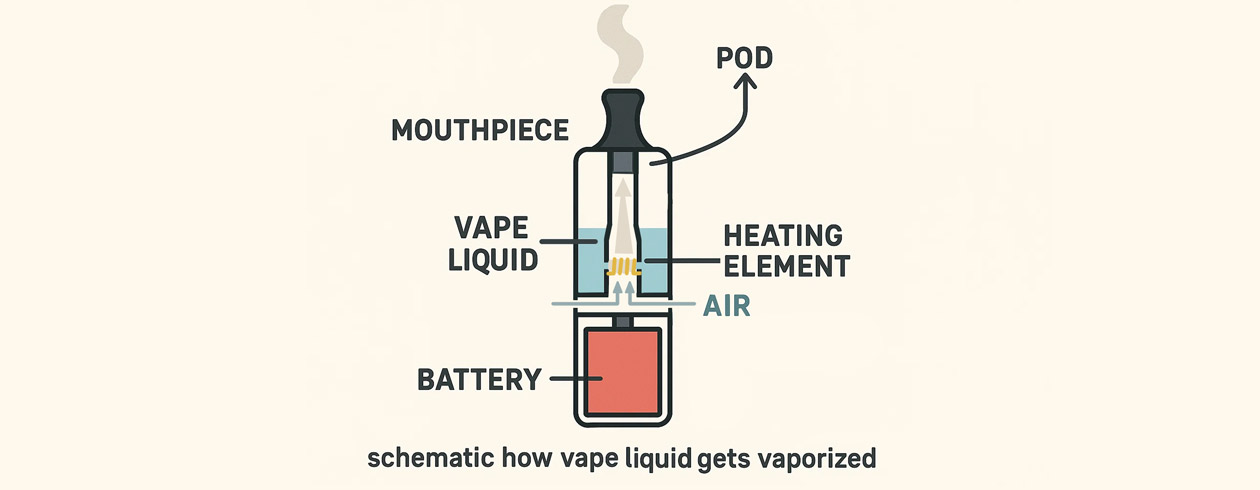
E-cigarettes always consist of five main components:
- Liquid: A mixture of base, nicotine, and flavouring that determines the taste.
- Battery/battery mod: The energy source that powers the heating coil. Available with built-in or replaceable cells.
- Atomiser (coil): The centrepiece that converts liquid into vapour using a heating coil and wicking material. The resistance in ohms influences the amount and temperature of the vapour.
- Tank: Stores the e-liquid and feeds it to the wicking material in the coil.
- Mouthpiece: For inhaling the vapour, available in various shapes and materials for individual comfort.
This is how vapes work: The battery supplies power and contains a cell that serves as the central energy source. The battery is not only crucial to the functioning of the device, but also represents an important environmental consideration, as it can be problematic when disposing of disposable vapes. The coil heats up as current flows through it. When the liquid is heated, chemical interactions between the various ingredients can occur, potentially producing harmful by-products. The liquid vaporises. The user inhales the vapour.
How Harmful Are Vapes?
Vapes are often marketed as a less harmful alternative to tobacco products such as cigarettes. It is true that vaping produces significantly fewer harmful substances, as no combustion takes place. Nevertheless, vapes are by no means risk-free: consumption poses potential dangers particularly for young people and non-smokers – such as the development of nicotine addiction or acute nicotine poisoning ("nicotine shocks") from excessively high doses. Furthermore, studies show that certain ingredients in liquids can release harmful substances at high temperatures.
Comparison: Vape vs. conventional (tobacco) cigarettes
| Kriterium | Vape | Tabakzigarette |
|---|---|---|
| Teer | ❌ Nicht enthalten | ✅ Enthalten |
| Verbrennung | ❌ Keine Verbrennung | ✅ Ja |
| Schadstoffmenge | 🚫 Deutlich geringer | 🔥 Hoch |
| Geruchsbelästigung | ❌ Minimal | ✅ Stark |
| Nikotin (optional) | ✅ Optional | ✅ Immer enthalten |
Note: Vapes are considered less harmful in comparison – however, they are not risk-free. The long-term effects have not yet been fully researched. Consumption is particularly discouraged for non-smokers or young people, but they can be a genuine alternative for regular smokers or help make quitting smoking easier.
Are vapes without nicotine harmful?
Even nicotine-free vapes can pose health risks. Although the addictive substance nicotine is absent, the liquids frequently contain flavourings whose inhalation can be problematic. Studies indicate possible irritation of the airways as well as allergic reactions. Since the research has not yet been conclusively established, caution is advised when consuming them. Conclusion: Even though vapes are considered less harmful than conventional cigarettes, they are by no means safe for your health. Young people in particular should be aware of the possible risks and, given that consumption is only permitted from the age of 18, should not expose themselves to these concerning substances. For smokers who wish to switch away from tobacco, the e-cigarette can be a sensible intermediate step – provided it is used responsibly.
From what age may one purchase vapes?
In Germany the rule is: from the age of 18. This also applies to nicotine-free e-cigarettes and liquids. Sale to minors is prohibited by law. Online retailers are obliged to carry out age verification. Info: In many other countries, comparable age restrictions apply to the purchase and consumption of vapes. When travelling or ordering online, you should therefore make sure to find out about the applicable local legal regulations.
Are you allowed to take vapes on a plane?
| Aspekt | Erlaubt? | Hinweis |
|---|---|---|
| Gerät im Handgepäck | ✅ Ja | Muss ausgeschaltet sein |
| Liquid im Handgepäck | ✅ Max. 100 ml pro Flasche | In 1-Liter-Beutel, max. 10 Flüssigkeiten |
| Nutzung im Flugzeug | ❌ Nein | Streng verboten |
Tip: Also check with your airline for current guidelines. Some airports also prohibit vaping in the terminal.
Disposing of vapes: how to do it correctly
🔄 What goes where?
| Bestandteil | Entsorgung |
|---|---|
| Einweg-Vape | Wertstoffhof / Sammelstelle für Elektroschrott |
| Akku (fest verbaut) | Ebenso Elektroschrott |
| Liquidreste | Hausmüll (in kleiner Menge, fest verschlossen) |
| Verpackung | Gelber Sack / Recycling |
⚠️ Important: Never throw batteries/devices with batteries into general waste – risk to the environment & fire hazard! Even small devices contain lithium-ion batteries.
FAQ: All about vaping
How does the consumption of e-cigarettes affect the cardiovascular system?
Studies suggest that the consumption of e-cigarettes can impair vascular function. Particularly in young adults (e.g. between the ages of 17 and 25), there are initial indications of effects on the cardiovascular system. Even though the effects are smaller than with conventional cigarette consumption, a health risk remains.
Are disposable vapes more dangerous than reusable models?
Disposable e-cigarettes frequently contain highly concentrated amounts of nicotine and are particularly popular among young people. Due to their easy availability and comparatively low price, they are considered a common entry point – and therefore carry an increased potential for addiction. They also cause ecological problems, as they are often not disposed of properly.
What substances does the vapour from e-cigarettes contain?
The vapour from e-cigarettes contains propylene glycol and glycerine as well as flavourings and, where applicable, nicotine. Studies have also detected traces of metals, acetaldehyde, and formaldehyde. These substances are usually produced by overheating of the heating coil or by the use of inferior materials.
Is there a ban on disposable e-cigarettes?
In Germany, a complete ban on vapes has not yet been implemented; however, such a measure is being intensively discussed in the context of youth protection and sustainability. Some countries, such as France, have already announced a future ban. Such a ban is also advocated in international position papers by specialist societies.
Why is vaping a trend among young people?
Vaping is considered a modern lifestyle. The stylish devices, sweet flavours, and strong presence on social media make e-cigarettes particularly attractive to young consumers. However, this leads to a dangerous misconception: many people underestimate the health risks – particularly in comparison to conventional tobacco cigarettes.
What is the difference between vaporisers, e-hookahs, and vapes?
Vaporisers are devices that usually gently heat herbs, plant-based components, or solid substances, whereas e-hookahs and vapes vaporise liquid e-liquid. The flavour of e-hookahs is often sweeter and more closely modelled on the taste of hookah tobacco, while vapes tend to be more compact and designed for everyday use. All three product types carry similar health risks – particularly when used improperly or consumed regularly by young people.
Do e-liquids contain dangerous substances?
E-liquids consist of so-called carrier substances such as propylene glycol and vegetable glycerine, as well as flavourings and, where applicable, nicotine. According to current studies, harmful substances such as formaldehyde or heavy metals can form when exposed to intense heat – particularly when used improperly or with low-quality devices.
Conclusion: What You Should Know About Vapes
- Vapes are a modern alternative to cigarettes – particularly popular among switchers
- No tobacco, no tar – but not without risks
- A wide variety of flavours and device formats allow for individual vaping experiences
- Legally regulated: not available to under-18s, use on aircraft prohibited
- Sustainability: make sure to dispose of your devices properly/li>
You might also like
Knowledge area