
Our offer is only for you if you are of legal age. Please confirm that you are at least 18 years old to proceed.


Hookah vs Vapes: The Ultimate Comparison
 Updated April 20, 2026 5 min
You love the hookah experience that a relaxed hookah session gives you, but you keep hearing more and more that vapes and e-cigarettes are supposed to be „better"? And now, on top of that, a third option has recently appeared in the hookah world: electric hookah systems like the XKAH Pro.
Many people ask themselves: what actually are the real differences? What is more harmful, what is cheaper, what tastes better – and which one works best in the long run?
In this article we take a look at classic hookah, vape/e-cigarette and electric hookah (XKAH). By the end you will know pretty precisely what suits you.
Note: You can find more information on the topic How harmful is hookah? in our blog article on this subject.
What to expect in this article
- The three systems compared: classic hookah, vape and electric hookah
- How they work: burning, vaporising or heating electrically
- What really matters for health, keyword carbon monoxide
- Nicotine-free tobacco alternatives for the hookah
- Addiction potential, costs and the environment in check
- Taste and experience: what suits whom
1. The three systems briefly explained
Classic hookah
With the traditional hookah, tobacco is heated with glowing charcoal. This creates smoke that is filtered and cooled by water. Hookah is above all a ritual: setup, bowl packing, heat management, smoking together.
Vape / e-cigarette
Vapes are very easy to handle. They vaporise a liquid (propylene glycol/PG, vegetable glycerin/VG, flavours, optionally nicotine) via a heating coil. This creates aerosol (vapour), not smoke. Because no combustion takes place, no tar and practically no carbon monoxide (CO) are produced – a key difference to the hookah.
Electric hookah / XKAH
The XKAH Pro is an electronic bowl or E-HMD that replaces charcoal, bowl and heat management in one system. You still use real hookah tobacco or tobacco substitute, but the heat source is electric – so without charcoal. Exactly because of this, the biggest problem factor of a classic session is eliminated: CO and combustion by-products from charcoal. We also published a detailed article on this mid-year: Electric Hookah: The Future of Hookah Enjoyment?
2. Differences at a glance
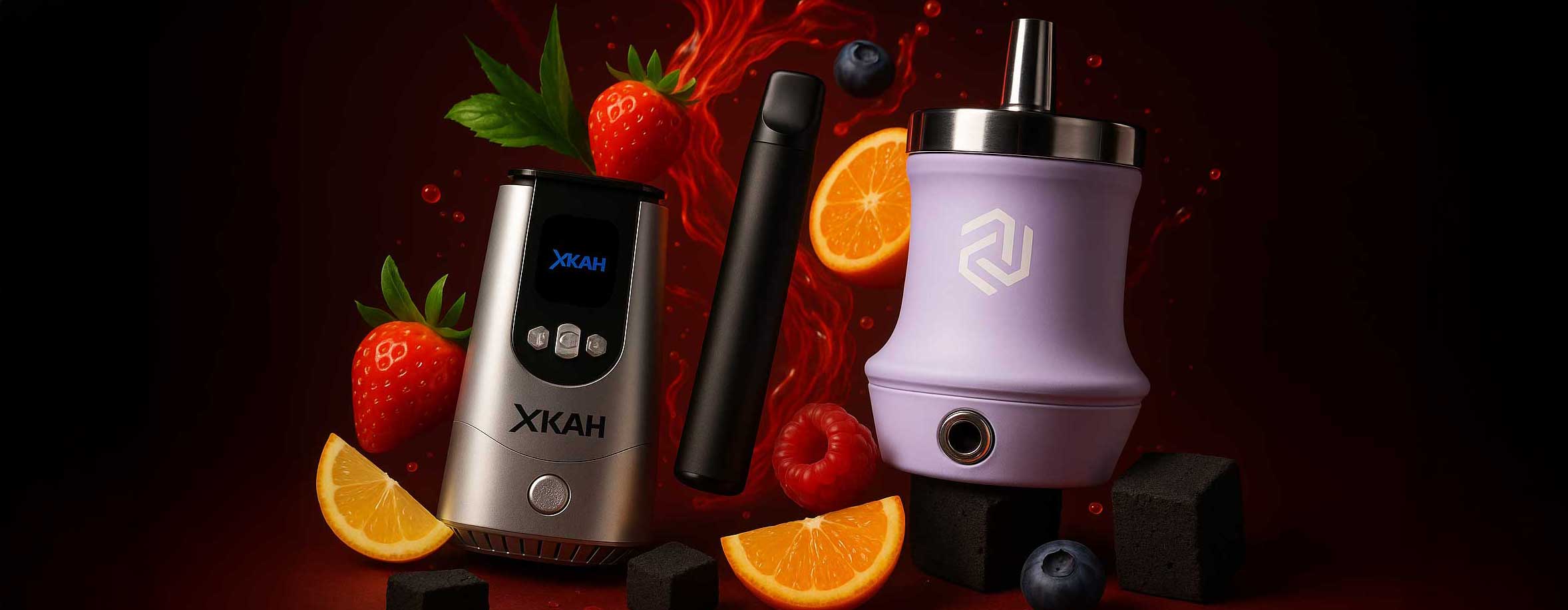
| Criterion | Classic hookah | Vape/e-cigarette | Electric hookah (XKAH) |
|---|---|---|---|
| Heat source | Charcoal (combustion) | Coil (vaporisation) | Electric heating chamber |
| Smoke/vapour | Smoke | Vapour/aerosol | Vapour from tobacco/tobacco substitute |
| Carbon monoxide | high due to charcoal | practically none | strongly reduced |
| Main pollutants | CO, tar, PAHs a. o. | fewer pollutants, no tar/CO | less CO/PAHs than charcoal hookah |
| Nicotine | depending on the filling: normal tobacco contains nicotine, cellulose/tobacco substitute is nicotine-free | precisely dosable (also 0 mg) | depending on the filling: like hookah – tobacco with nicotine, tobacco substitute nicotine-free |
| Use | stationary, session ritual | anywhere, spontaneous | session ritual, but without charcoal |
| Feeling/experience | classic hookah feeling | „vape feeling" | very close to classic hookah |
In context: Electric hookah is not automatically harmless, but the elimination of charcoal clearly reduces one of the biggest pollutant drivers (especially CO) and if you want to do without the nicotine content in the tobacco entirely, you can fill an electric smoking device like the XKAH with nicotine-free tobacco and thereby get a smoking experience that very strongly resembles that of a normal water pipe, but also strongly accommodates trends like vaping and shows only few differences.
3. How they work: burning vs. vaporising vs. heating electrically
Classic hookah: smoke through charcoal
Charcoal glows, tobacco smoulders – in the process tar, carbon monoxide and many combustion products are created. CO is a real risk factor with hookah, there are regularly documented CO poisonings after hookah sessions, especially in poorly ventilated rooms.
Vape: vaporising without tobacco combustion
Liquids are only heated and vaporised. As a result, the pollutant load is significantly lower than with combustion – but not zero; depending on the device, temperature and liquid composition, irritants can be produced.
XKAH / electric hookah: tobacco, but without charcoal
Here the tobacco or tobacco substitute stays the same, but the charcoal is eliminated. Measurements of charcoal-free or electrically heated hookah setups show almost no CO and significantly fewer combustion by-products compared to charcoal setups. In short: the hookah flavour remains, the charcoal risks drop massively.
This option is likely to be the healthiest way of a hookah experience, but for many hookah bars and for consumers with a personal preference for the original hookah tradition it is probably less attractive.
4. Health: what is more harmful?
Classic hookah
- Highest risk in the comparison, especially due to charcoal CO and combustion substances.
- CO exposure can be acutely dangerous.
Vape
- Significantly less harmful than classic smoking (tobacco combustion), because no combustion takes place.
- The frequently cited „~95% less harmful" assessment comes from a Public Health England review and refers relatively to cigarettes, not to „completely safe".
- Expert bodies see vapes as lower in pollutants, but emphasise uncertainties regarding long-term consequences and dependence.
Electric hookah/XKAH
- Significantly less CO/PAHs than classic hookah, because no charcoal burns.
- Nevertheless, it remains inhalation of heated substances; not risk-free, but a clear pollutant reduction in the hookah context.
Short conclusion on health: classic hookah tradition (most risky) → electric hookah/XKAH (noticeably reduced) → vape (lowest in pollutants in the comparison, but not harmless).
5. Extra option: nicotine-free tobacco alternatives for hookah
Many people automatically think of nicotine with hookah – but there have long been tobacco alternatives without nicotine. Such products are often sold as tobacco substitutes and consist, for example, of cellulose or herbal bases soaked with molasses and flavours.
In our category hookah tobacco without nicotine we have gathered all the products that you can smoke in a hookah without nicotine.
Cellulose tobacco substitute = without nicotine and without tar
- Nicotine-free: cellulose products contain no tobacco and thus no nicotine.
- Tar is only produced when tobacco is burned. With cellulose tobacco substitute, mainly the molasses vaporises; that is why no tobacco tar is produced and significantly fewer combustion substances arise. Important: it remains inhalation of heated aerosol – so not „healthy", but without the classic tobacco combustion products.
The „as little harmful as possible" hookah setup
If you want the way a hookah works, but want to reduce the risks as far as realistically possible, one of the most sensible ways at the moment is:
XKAH (charcoal-free) + cellulose tobacco substitute (nicotine-free).
XKAH takes out CO and charcoal combustion substances.
Cellulose tobacco substitute takes out nicotine and tobacco tar.
This is not a medical guarantee, but a realistic best-practice combination for reducing pollutants and addiction potential with hookah.
6. Addiction potential – why vapes are „problematic"
Why vapes have a disadvantage here
- Constant availability, usable everywhere.
- No natural session limit. With hookah you know: the bowl is empty, the session is over.
- With vaping the barrier is practically zero: one puff here, one puff there – and the day turns into a permanent session.
As a result, nicotine addiction can be driven more strongly, because the brain constantly receives small reward impulses. Health authorities warn especially with young users about dependence and a habituation to permanent nicotine consumption. In addition, the barrier to starting smoking through vapes is lower than ever before.
How XKAH and classic hookah tick differently
Both work as a clearly defined session. Setup and time investment automatically ensure more moderation. That does not mean that hookah cannot be addictive – but the consumption logic is a different one.
7. Cost comparison
Classic hookah
- Setup usually more expensive.
- Ongoing costs through tobacco + charcoal.
- Per bowl roughly 4–6 € depending on tobacco/charcoal.
Vape
- Cheaper entry (device + liquid).
- Liquids & coils cost on an ongoing basis, per puff usually cheaper.
- Disposable vapes are under massive political pressure, a ban is being concretely prepared.
XKAH / electric hookah
- Purchase higher than a normal HMD, but you save charcoal permanently.
- Economically usually between hookah and vape.

8. Environmental aspect: better avoid disposable vapes – and if you do use them, dispose of them correctly
Disposable vapes are a huge problem. They are sold like throwaway articles, but are electronic waste (lithium battery, electronics, metals). Because they often end up in household waste, valuable raw materials are lost and fire risks arise from batteries in waste facilities. You can find out why disposable vapes will soon be banned entirely in our blog article: Vapes Banned in Germany: the current situation, consequences & the best alternatives for smokers
That is why our very clear recommendation:
- If possible, do not buy disposable vapes.
- If used anyway: dispose of them only as e-waste (collection point/recycling centre or return in retail).
Rechargeable, refillable devices are the significantly more sensible choice here.
9. Taste & experience
Hookah
- The appeal of the ritual and the social feeling.
- Flavours strongly influenceable through the setup, but the most diverse and with the greatest depth.
Vape
- Huge selection of flavours, very flexible.
- The feeling is different: less session, more everyday.
XKAH
- Very close to the classic hookah feeling, because real tobacco is used. With tobacco substitute the smoking feeling also goes more in a vape direction, as a large part of the pollutants and toxins is missing.
- Advantage: constant heat, no charcoal management.
Conclusion on e-hookahs, e-liquids, vape pens, and (e-)hookah devices
These days it is no longer a „hookah vs. vape", but a three-way contest:
- If you are looking for a classic hookah experience, you cannot get around the classic hookah with water and tobacco. But you also have the highest exposure to pollutants and to charcoal.
- Vapes are lower in pollutants than combustion systems, but have a clear risk of overconsumption through permanent availability – and disposable vapes are ecologically a no-go.
- Electric hookah like the XKAH reduces CO massively, but remains inhalation of heated substances.
Anyone who wants to enjoy hookah with as few pollutants and as little addiction potential as possible has a realistic best-practice combination:
XKAH (charcoal-free) + cellulose tobacco substitute (nicotine-free, without tobacco tar) – with a real hookah feeling, but with clearly reduced disadvantages, although this will probably be rather unattractive for long-term smokers, as the nicotine kick is missing.
FAQ: hookah vs. vape
What is more harmful: hookah, vape or electric hookah?
Even though with a hookah tobacco does not burn to the same extent as is the case with cigarettes, in the direct comparison it holds: classic hookah is the most burdening, especially with a view to the charcoal (CO and combustion by-products). Vapes are on average lower in pollutants, because nothing burns, the liquid is merely vaporised. Electric hookahs like the XKAH lie in between: the tobacco remains, but the charcoal is eliminated – as a result, above all the CO exposure drops significantly. None of the options is entirely risk-free, but the pollutant drivers are different.
Does an electric hookah really taste like a normal hookah?
Very close. Because you use real hookah tobacco or tobacco substitute, the aroma is largely preserved and the typical session feeling also remains. The biggest difference is the more constant heat without charcoal management – this often makes the result even more reproducible.
Why does carbon monoxide become a problem with the classic hookah?
CO is produced through the combustion of the charcoal. In closed or poorly ventilated rooms it can accumulate quickly. That is exactly why there are repeatedly documented CO poisonings after hookah sessions. Electric systems strongly reduce this risk, because no charcoal glows.
Are vapes a good alternative if you want the hookah feeling without the ritual?
If you are looking for something spontaneous for in between, yes. Vapes quickly deliver flavour and vapour without setup. What makes them less „hookah-like": the session ritual is missing – as a result overconsumption is more easily possible, especially with nicotine.
Which type of vape comes closest to a hookah in terms of draw feeling?
Most likely devices with an open draw (DL/sub-ohm). They produce a lot of vapour and feel „more cloud-heavy" than classic beginner devices. If you would rather vape comfortably and on the side, pod systems / systems with pods are a compact alternative – but these are clearly further away from a hookah session in terms of feeling.
Is an e-hookah the same as a vape?
Yes, but: „e-hookah" is actually just a marketing term for an e-cigarette or vape, often for larger, more powerful models that produce more vapour. Besides classic e-hookahs, there are also disposable e-cigarettes and pod systems that represent an alternative as innovative, portable devices.
But there are also electronic hookahs, likewise called e-hookah by some. These electronic hookahs are water pipes that heat hookah tobacco via electricity and thus work more like a real hookah with water cooling and have nothing to do with vapes (e-hookahs).
Can you enjoy vapes or electric hookah nicotine-free?
Yes. With vapes this is easy via 0 mg liquids. With hookah and XKAH you can use nicotine-free cellulose tobacco substitute instead of tobacco. This eliminates nicotine, carbon monoxide and tobacco tar, while with the XKAH you still keep the typical hookah setup.
Is an electric hookah financially worth it?
If you smoke hookah regularly, an investment can be worthwhile: the purchase is higher than for a normal HMD, but you save charcoal permanently. In the long run, in terms of cost you often land between classic hookah and vape – with the advantage that the session experience is preserved and significantly less carbon monoxide is consumed.
Can you get away from hookah smoking with vaping?
Yes – with limitations. Hookah is usually smoked more in sociable company and not permanently. If you smoke hookah very often and want to get away from it, a vape can be a practical alternative for you, especially if you gradually reduce the nicotine content.
Studies on smoking cessation show that e-cigarettes can help cigarette smokers to quit. However, this data does not refer directly to hookah consumers. At the same time it holds: because vapes are available at any time, this can more easily lead in everyday life to more frequent consumption and stronger habituation than with a clearly limited hookah session.
If you only enjoy hookah occasionally as a ritual with friends, vaping is therefore not automatically the better alternative. In that case it is often more sensible to switch step by step to nicotine-free tobacco alternatives like Hookahsqueeze or Smoke Island – and, if the investment suits you, to consider an electric system like the XKAH.
This way the social session feeling is preserved, while above all carbon monoxide and other combustion substances are significantly reduced and the addiction potential turns out lower overall. In general, however, it holds: any consumption is worse than no consumption.
You might also be interested in
Knowledge